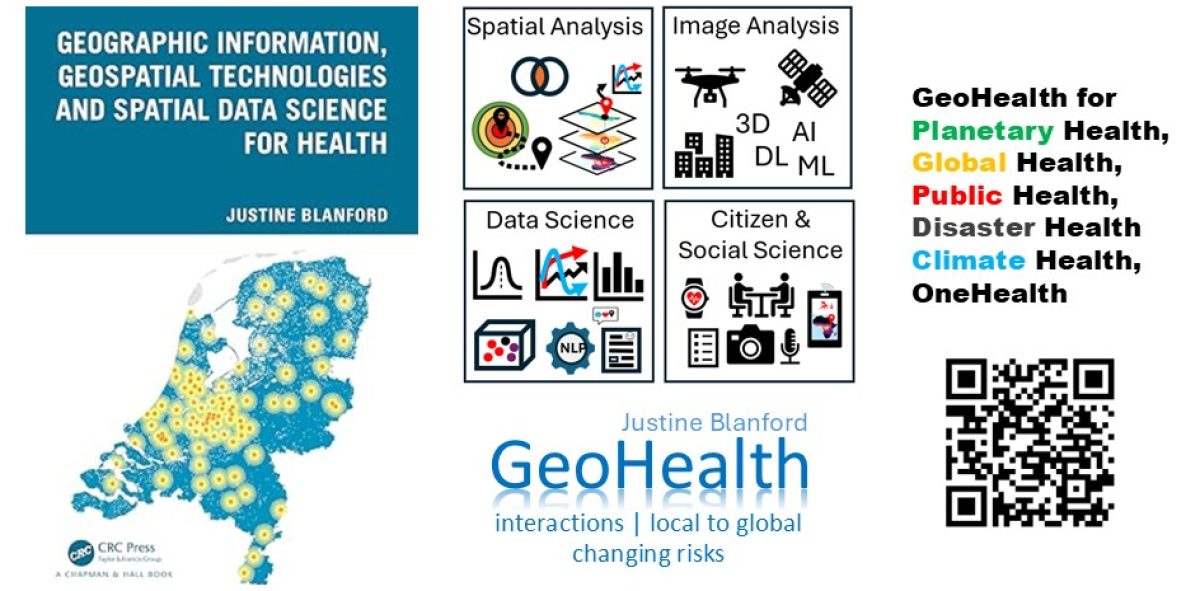
GeoSpatial4Health is the integration of geographic information, technologies and spatial concepts with epidemiology. Health and disease are complex and requires a dynamic approach to understanding the interactions driving the patterns and outcomes that we see.
Geographic Information, Geospatial technologies and GIScience play a vital role in adding context: visualizing where and when diseases occur in space and time, understanding why they may be prevalent, who may be affected and how to respond.
- Maps allow us to contextualize and understand what is taking place at a particular location at a particular time.
- GIS and GeoSpatial Technologies allows us to interact with the data so that we can explore interactions and relationships.
At GeoSpatial4Health we take an integrated geospatial approach to health intelligence where we consider the ecology of the disease (disease triangle), the response and what and how to communicate.
integrated intelligent geospatial health approach
when we consider health and disease we need to think of three elements:
- Ecology: (what &where & when & why) understanding the disease and drivers of the disease?
- Response (Control & Prevention and Diagnosis & Treatment): (who is affected, what we do about it) how do we minimize risks? what actions do we need to take? (what healthcare and infrastructure are available and how to access) how can we access the treatment we need in a timely manner? what policies, planning and infrastructure are needed?
- Communication: inform the public of where and when risks are; actions to take and availability of treatment
ecology of disease
Understanding health and disease is really all about the interactions. Interactions between the (host (behaviour/lifestyle) and a pathogen (agent) in the environment where the intensity can be influenced by exposure and incubation period of the agent.
Healthr+o = ((A ∩ H ∩ E )+((HE) x V x CC))) *time
Health Risk (r) and Outcomes (o) = ((Agent – Host – Environment)+(Hazard x Exposure (HE)) x Vulnerability x (lack of ) Coping Capacity (CC)) * time
Understanding health and disease is complex. We have to think simultaneously about the interactions between an agent and a host at various spatial and temporal scales in a dynamically changing environment.
To understand these complexities at a local or global scale we need to fuse varied data sources that capture different geographies as well as be able to perform a wide variety of analyses at different spatial and temporal scales.
It is only through this integrated approach that we can understand the ecology of disease and the determinants that are driving the health risks and outcomes.
response
Response (Control & Prevention and Diagnosis & Treatment): (who is affected, what we do about it) how do we minimize risks? what actions do we need to take? (what healthcare and infrastructure are available and how to access) how can we access the treatment we need in a timely manner? what policies, planning and infrastructure are needed and at what scale?
Ensuring equality in access to health facilities and critical infrastructure to minimize health risks.
communication
Visualisations and symbolisation with statistic and dynamically interactive maps and graphs. Transforming data from excel spreadsheets, outbreak reports into geo-enabled structured data that can be used to create statistic, interactive or dynamic maps.
Not only is communication about the visualisation and symbolisation but also about having the data structured and organised in a way that allows for real-time, efficient and effective information sharing.
Geospatial for a geoAI-enabled society
Interested in learning more about how GIS, AI and geographic information can be used for managing health?
For more information view the website: geohealth_blanford
 GeoSpatial4Health